As Edinburgh served up some of its least hospitable November weather, the Centre warmly welcomed Michael Goebel (Graduate Institute, Geneva), to discuss his most recent project on urban ethnic segregation in the global south in the late 19th and early 20th centuries. Rosalind Parr was there to bring us this report, or you can listen again to the talk by following the Audiomack link below or on the CSMCH podcast channel.
For several years, Michael has been at the forefront of global history. His influential Anti-Imperial Metropolis (2015) examined migrant communities in interwar Paris, shining a spotlight on the formative experiences of Ho Chi Minh and Deng Xiaoping, amonst others. Speaking to the Centre’s current theme of ‘space,’ his current work reflects a deepening interest in the emerging sub-field of global urban history and seeks to bring historians and social scientists into dialogue on the question of ethnic segregation in global cities.
Michael’s paper presented preliminary research on an ambitious new project, whch takes as its starting point the assumption, found in the work of Saskia Sasson and others, that globalization exacerbates urban socio-spatial polarization. By examining ethnic segregation in multiple port cities in the global south, he argues, historians can unpack this widely held assumption and offer stimulating new insights to the debate.
Given Michael’s background in global history, it is not surprising that his research offers a consciously ‘decentred’ perspective. At issue is the dominance of the North American urban spatial model, based as it is on exceptional conditions of racial segregation, which has unduly influenced the global picture.
As Michael noted, in light of recent studies of urban cosmopolitanism in the global south, the assumed link between globalisation and ethnic segregation looks much less stable. One very important objective of Michael’s work is to bring observations found in rich, area-specific studies such as Su Lin Lewis’s Cities in Motion, into dialogue with a truly global, cross-disciplinary literature on the topic.
Drawing on an impressive variety of sources, Michael offered as case studies Havana, Manila, and Buenos Aires. Even after what he presented as preliminary findings, it was clear that levels of segregation manifested unevenly in different geographical contexts. Cosmopolitan Manila, for example, became increasing heterogeneous even as micro-segregation existed at the level of church seating arrangements. In Havana, the prevalence of racially structured domestic slavery hampered ethnic segregation due to the co-habitation of master and slave.
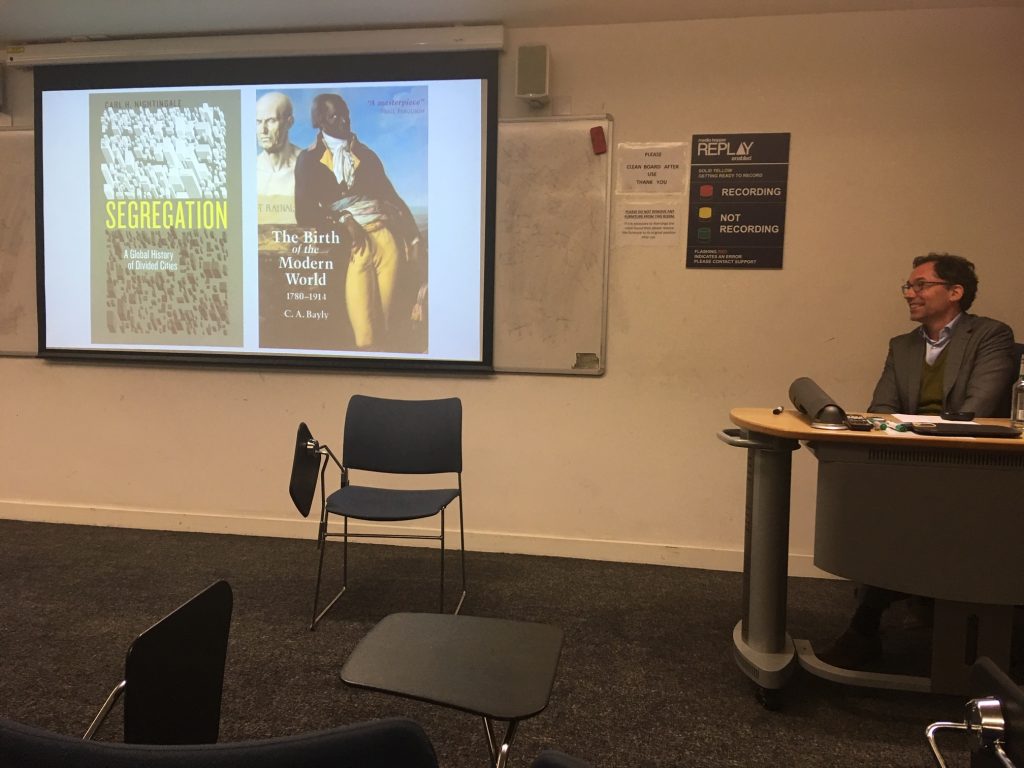
Yet Michael’s argument goes beyond the observation of local complexity and regional variation; his analysis is alert to the importance of timing and changes over time. The relatively early arrival of Italian migrants in Buenos Aires produced ethnic segregation based on their ability (in contrast to later-arriving Spanish migrants) to take advantage of lower land values in semi-urban areas. These findings point to striking historical contingency, as well as complexity and variation, in the development of urban ethnic segregation in a globalizing world.
In his comment, Edinburgh’s pre-eminent urban historian, Richard Rodger, drew attention to the important question of generational shifts in ethnic identities, amongst other responses. His remarks, along with comments and questions from the floor, suggest that Michael’s objective of instigating scholarly conversations around the big questions of globalization and urbanization will no doubt be achieved. We look forward to hearing more as the project develops.
Rosalind Parr is a temporary Lecturer in Modern South Asian History at the University of St Andrews. She is a CSMCH steering committee member.