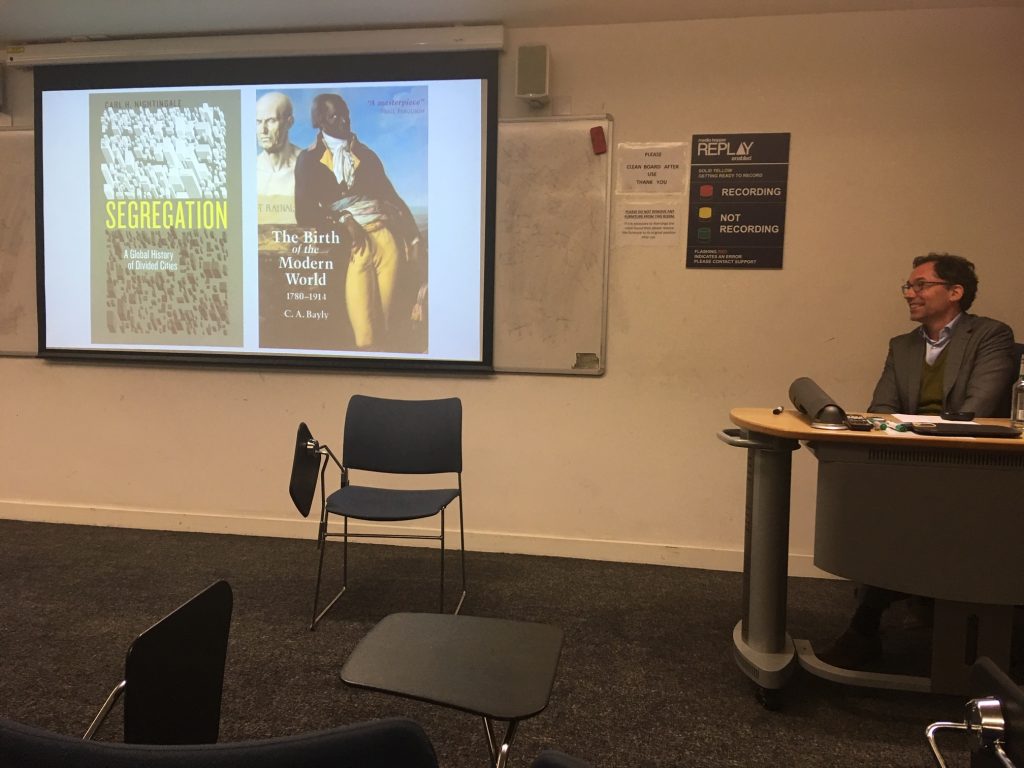
As Edinburgh served up some of its least hospitable November weather, the Centre warmly welcomed Michael Goebel (Graduate Institute, Geneva), to discuss his most recent project on urban ethnic segregation in the global south in the late 19th and early 20th centuries. Rosalind Parr was there to bring us this report, or you can listen again to the talk by following the Audiomack link below or on the CSMCH podcast channel.
For several years, Michael has been at the forefront of global history. His influential Anti-Imperial Metropolis (2015) examined migrant communities in interwar Paris, shining a spotlight on the formative experiences of Ho Chi Minh and Deng Xiaoping, amonst others. Speaking to the Centre’s current theme of ‘space,’ his current work reflects a deepening interest in the emerging sub-field of global urban history and seeks to bring historians and social scientists into dialogue on the question of ethnic segregation in global cities.
Michael’s paperpresented preliminary research on an ambitious new project, whch takes as its starting point the assumption, found in the work of Saskia Sasson and others, that globalization exacerbates urban socio-spatial polarization. By examining ethnic segregation in multiple port cities in the global south, he argues, historians can unpack this widely held assumption and offer stimulating new insights to the debate.
Given Michael’s background in global history, it is not surprising that his research offers a consciously ‘decentred’ perspective. At issue is the dominance of the North American urban spatial model, based as it is on exceptional conditions of racial segregation, which has unduly influenced the global picture.
As Michael noted, in light of recent studies of urban cosmopolitanism in the global south, the assumed link between globalisation and ethnic segregation looks much less stable. One very important objective of Michael’s work is to bring observations found in rich, area-specific studies such as Su Lin Lewis’s Cities in Motion, into dialogue with a truly global, cross-disciplinary literature on the topic.
Drawing on an impressive variety of sources, Michael offered as case studies Havana, Manila, and Buenos Aires. Even after what he presented as preliminary findings, it was clear that levels of segregation manifested unevenly in different geographical contexts. Cosmopolitan Manila, for example, became increasing heterogeneous even as micro-segregation existed at the level of church seating arrangements. In Havana, the prevalence of racially structured domestic slavery hampered ethnic segregation due to the co-habitation of master and slave.
Michael takes questions at the end of his talk
Yet Michael’s argument goes beyond the observation of local complexity and regional variation; his analysis is alert to the importance of timing and changes over time. The relatively early arrival of Italian migrants in Buenos Aires produced ethnic segregation based on their ability (in contrast to later-arriving Spanish migrants) to take advantage of lower land values in semi-urban areas. These findings point to striking historical contingency, as well as complexity and variation, in the development of urban ethnic segregation in a globalizing world.
In his comment, Edinburgh’s pre-eminent urban historian, Richard Rodger, drew attention to the important question of generational shifts in ethnic identities, amongst other responses. His remarks, along with comments and questions from the floor, suggest that Michael’s objective of instigating scholarly conversations around the big questions of globalization and urbanization will no doubt be achieved. We look forward to hearing more as the project develops.
Rosalind Parr is a temporary Lecturer in Modern South Asian History at the University of St Andrews. She is a CSMCH steering committee member.
In our fourth seminar of the semester, the CSMCH teamed up with the new Edinburgh Centre for Global History to invite Vanessa Ogle (Berkeley) to talk about her work on offshore tax havens. She used the Centre’s theme of ‘space’ to deliver a masterclass in how global history can be done effectively and innovatively. You can read Anita Klingler’s succinct seminar report, or listen to the recording via the Audiomack link below or via the CSMCH podcast channel (on iTunes or wherever you get your podcasts).
The topic of Vanessa’s talk was the emergence of so-called tax havens over the course of the twentieth century and her central argument was that decolonization, besides being a political, social, and cultural process, should also be viewed as a financial event.
In view of the constantly expanding nature of global capitalism, Vanessa’s work is underpinned by impressively extensive archival research, literally all over the globe, from Europe, to Australia, to the Bahamas and back. She began her talk by pointing out that the ‘offshore world’ consisted of four distinct elements: tax havens, with very low tax rates, special rates for foreign businesses, and strong bank secrecy laws; secondly, offshore finance; thirdly, ‘flags of convenience’ registries; and lastly, free trade zones. Her paper would focus on the first of those four elements, tax havens.
Their emergence, as Vanessa pointed out, was largely a product of the First World War and the postwar world. Many countries, the UK among them, raised or introduced new taxes during the war, thus prompting the development of tax havens in the Channel Islands and other locations in Europe. The second wave of tax haven development followed after the Second World War, particularly in the North Atlantic world, the Caribbean, and South-East Asia. In a third wave, further tax havens sprang up in the Pacific world in the 1980s and 1990s. From the 1980s onwards, Vanessa remarked, recalling Hannah Arendt’s arguments on colonial violence, financial instruments developed in the (formerly) colonial world began to make their way back to the metropole.
What Vanessa’s research led her to discover was a correlation between the moment when former colonies gained independence and a noticeable effort to move capital out of those places and into known tax havens. Her first example of this was the Swiss National Bank which, in the second half of the 1950s, began to notice an increasing number of foreign banks requesting permission to open in Switzerland.
Among them, were two Moroccan banks operating out of Tangier. Following the effective partition of Morocco in 1912, Tangier was brought under international governance and developed into a tax haven. When it was reunited with newly independent Morocco in 1956, however, Tangier stopped being attractive as a tax haven and capital was systematically moved elsewhere, for example Switzerland.
One of Vanessa’s slides, as simple as it was striking, listed some fourteen cases in which her archival research has allowed her to retrace similar capital flows from formerly colonised countries to international tax havens, at the very moment of upheaval in those areas and/or national independence for those countries.
During the first wave of decolonisation following the Second World War, in particular, places which had a significant European settler community witnessed the exodus not only of the European settlers themselves, fearing violence and repercussions under the new independent regimes, but also of their money. Examples which Vanessa discussed included that of capital being shifted from Kenya, in view of the Mau Mau Uprising, and Rhodesia to Caribbean tax havens such as the Bahamas; as well as white South Africans who decided to move to the UK, especially following the Sharpeville massacre of 1960, but chose to move their liquidated assets to Gibraltar instead.
Vanessa discusses decolonisation as a financial event
There was an awareness that these processes were going on even at the time, which earned the capital thus shifted the moniker ‘funk money’. Banks in emergent tax havens in fact made active efforts to attract capital, for example in Malta, which, while still under British control, offered pensioners who settled there very low taxes. Other groups which were targeted specifically by banks were minorities, such as the East African Indian population or Christians living in North Africa, who feared future political developments.
In another striking display of numbers, Vanessa pointed to the vastly different tax rates between (former) colonies and the metropole; a discrepancy which, in her analysis, led to the creation of a taxation culture which tried to avoid repatriating wealth, for example to the UK, and move it into tax havens instead.
Vanessa ended her talk by explaining that the channels created by bankers between the developing world and international tax havens continue to be used today by corrupt local elites to move their assets out of their countries, causing these economies significant losses in tax revenue and exacerbating their economic difficulties. In the end, the question of who had had the power to buy up the assets which were being sold at the end of Empire, has in fact set up power structures in the decolonised world which endure today, lending strong credence to Vanessa’s argument that decolonisation was a financial event.
Vanessa’s talk was followed by a brief comment by Martin Chick (Edinburgh). He reminded the audience that individuals who had fixed assets in colonial settings, such as land or houses, and chose to liquidate them when moving elsewhere, had virtually no incentive to move their money to places like the UK or France, as both countries were, up to the late 1960s, active in nationalising industries. There were therefore good reasons not to want one’s assets in the developed world, and, depending on one’s approach to risk, investments outside the developed world were much more attractive. The stability of the Bretton Woods system thus encouraged the development of overseas tax havens where its rules did not apply. Following the end of the Bretton Woods system in 1971, however, tax havens did not begin to disappear, but continued to flourish instead. Martin ended by observing that the ‘funk money’ flowing freely around the world in the last few decades has had the effect of driving up asset prices globally.
In the question and answer session, audience members invited the speaker to share her reflections on the political-ethical dimensions of her research project. How can or should historians position themselves while also avoiding writing a ‘how-to’ manual on tax evasion? Further, related, questions addressed the changing culture of ‘scandalisation’ around tax evasion; and possible solutions to this ongoing phenomenon. While our speaker was too wise to make predictions about the future, some of Vanessa’s suggestions focused on the necessity for a certain political moment, which, in her analysis, the growing discourse on inequality since the financial crisis of 2008 has potentially provided, and in which changes to legislation might be possible. Nevertheless, the cycle of plugging existing loopholes while bankers and lawyers try to find new ones will likely continue as a constant game of cat-and-mouse.
Anita Klingler is a PhD student in History. Her research interests lie broadly in twentieth century European history, political and colonial violence, and coming to terms with a violent past. Her thesis compares attitudes towards political violence in interwar Britain and Germany. She is a CSMCH steering committee member.
The CSMCH took a decidedly theoretical turn this week as the legal scholar Davina Cooper (King’s College London) shared with us the conceptual foundations of her new ESRC project on reforming legal gender identity. She challenged us to think differently about what gender is, what it could become, and what sorts of spaces it could inhabit. Our dedicated scribe, Calum Aikman, was there to take notes and send this report, or you can listen again to the talk by following the Audiomack link or tuning in to our podcast channel on iTunes or wherever you get your podcasts.
In an age when gender is an increasingly important feature on the political landscape, how can we seek to resolve the contentious issues that arise? How can gender identity hope to move beyond today’s climate and become something new? And what chance is there for agreement and unity when feminist campaigners are frequently at odds with one another? These are just some of the questions which animated Davina’s paper on ‘reimagining the conceptual space of gender’.
Davina began by briefly illustrating the recent history of gender politics, arguing that the main themes are by no means new; many feminist essentialist arguments, in particular, have been aired at regular junctures in the recent past. These have, however, been considered secondary to the broader challenge of how to define women and womanhood without resorting to overtly male, middle-class modes of thought.
But the increased prominence of debates pertaining to the rights of transsexual men and women, amongst other things, has shifted emphasis towards ideas that specifically evaluate gender. Many governments throughout the world have been involved in passing legislation that seeks to further ‘trans’ rights – Davina mentioned Malta, Denmark and the Republic of Ireland as three countries that have taken the lead in formulating a light-touch approach to gender transitioning.
Yet progress remains uneven, and even those states with a more interventionist ethos have found it difficult to avoid issues – such as sex-divided spaces and provision of ‘puberty blockers’ – that generate a great amount of controversy. (In some instances, it is established feminist groups that have raised objections – such as over proposals to make gender reconstruction easier, for example.)
Davina sketched out two contesting concepts that influence the way many of us think about such matters. ‘Gender as Domination’ (GDom) was described as a paradigm in which exploitation is considered a part of everyday relations between men and women; its proponents thus focus primarily on combating those factors that make it possible, with a defence of rights and freedoms as one of the main goals.
In contrast, ‘Gender as Diversity’ (GDiv) sets out to tackle the hardships experienced by gender-fluid people, and adopts a more outrightly radical attitude that emphasises trajectories of self-realisation. Davina explained that there is no single right or wrong answer to the narrative of gender experience, and that both GDiv and GDom are valuable as interpretive models.
Of course, both these approaches also have flaws: GDiv is unduly concerned with subjective needs, while GDom – although relational in its understanding of how men and women shape each other – can potentially become over-focused on ‘dystopian’ visions of male predatory behaviour and female victimhood.
Can these two conceptions of gender coexist in a way that allows for positive dialogue, rather than antagonism? What Davina suggests is a move away from such binary divisions, by introducing alternative ideas that illuminate other social inequalities and, in doing so, provide a ‘hopeful conceptual line’ that can go beyond the stale assumptions of the ‘gender wars’.
Her own idea is to offer a utopian perspective by thinking in terms of ‘prefiguration’ – a concept which aims to challenge the restrictions inherent in a given situation by proposing that one should act as if the desired alternative is already in place. This creates space for play and imagination, to work within a plural framework that assumes ideals and reality to be part of one continuum. Although Davina stressed that for any such theory to be effective an awareness of objective evidence is still necessary, her hope is that such an approach will allow people to concentrate on identifying what gender might become, rather than be trapped in competing, often authoritarian definitions of what it already is (or, indeed, what it is not).
Davina further argued that prefiguration can provide a new dimension to gender politics, by allowing it to engage with various socio-economic issues that highlight other aspects of the gender experience – family life, for instance, or care-work. She noted that legislators already have the potential to act in a prefigurative fashion, by changing meanings and notions of gender while introducing political reforms.
Even so, she argued that individuals ultimately have a greater degree of agency than the state does, because they are not bound by the limitations of what is ‘real’ and ‘right’, and can thereby give their imagination free rein. She did acknowledge that the utopian nature of prefiguration has its drawbacks, not least because harmful relations between men and women cannot simply be wished out of existence. But at least it brings forth new concepts to work with: these ‘fruitful pathways’, as she described them, have the potential to go beyond current struggles by substituting competition and criticism with something more constructive.
Davina answers questions in a fascinating Q&A session after the talk
Commenting on the paper, Mathias Thaler (Edinburgh) began by conceding that he did not fundamentally disagree with any of the main points raised in the paper, noting that Davina’s portrayal of prefigurative politics as a collective reflection on what gender could mean allows for a genuinely new perspective on an otherwise frequently terse debate. Nonetheless, he expressed some reserve about what he described as the ‘ambivalent’ nature of prefiguration as an idea, observing that its ‘playfulness’ can only oscillate between the seemingly contradictory principles of utopian idealism on the one hand and realpolitik on the other. This, he suggested, has the potential to cause conflict, especially if the underlying principles are not properly understood by the wider public. The frequent accusations of failure that have dogged the Occupy movement, for example, illustrate what happens when a performative and experimental movement is unable to articulate its agenda on its own terms.
Related to this, while Davina suggested that activists were empowered through the act of prefiguration, Mathias wondered just how many actual examples of this there actually are, and commented more generally on his feeling that there wasn’t much ‘empirical substance’ to the paper. He was also sceptical about how effective the legal system could be in enabling prefiguration, given the capacity of the law to erode its playful, subversive qualities, and ruminated on the involvement of academics themselves – should they seek only to bear objective witness, or is it their responsibility to mediate actively in the issues they are studying?
Calum Aikman is a PhD student in History. His research mostly focuses on twentieth-century British and Scottish politics, trade union history and the fortunes of the Labour Party in the post-war era. His thesis is on the political thought of the Labour Party’s ‘revisionist’ right wing in the 1970s. He is a CSMCH steering committee member.
For this week’s seminar, we explored an entirely different aspect of our theme of space: the built environment. We broke with tradition and invited one of our own – our new lecturer in environmental history, Emily Brownell – who took us on a fascinating journey through the urban sprawl of 1970s Dar-es-Salaam and the concrete fantasies of postcolonial socialism. Mathew Nicolson was our note-taker on the day and you can read his report below. You can also listen again to the whole lecture on Audiomack or by tuning in to our podcast channel (accessible via iTunes or your favourite podcast app).
By framing the city of Dar es Salaam as the explicit subject of her research instead of simply the backdrop for its people and elites, Emily’s research on post-colonial building materials provides an innovative approach to the history of post-independence Tanzania.
She began her paper by outlining the political, social and economic background of 1970s Tanzania. Noting that the short timespan of this period makes her study unusual within environmental history, a field more commonly examined over centuries rather than decades, Emily explained her approach by emphasising the rapid changes Dar es Salaam experienced during these years. On one hand, the state ideology of ‘Ujamaa’ as advocated by Tanzania’s first President, Julius Nyerere, led to the government concentrating its development funding in rural parts of the country in order to address inequalities inherited from the colonial area. On the other, the combined impact of famine, the 1973 Oil Shock, a collapse of commodity prices and the 1978-9 war with Uganda sparked a trend of rapid urbanisation, creating intense pressure on Dar es Salaam’s infrastructure at a time when funding for urban development was already scarce.
A colonial-era map of Dar Es Salaam
These conflicting pressures form the core of Emily’s study. She asked how urban residents shaped their environment in the face of anti-urban state policies and, more broadly, how Tanzanians subsequently adjusted their material and ideological expectations for the future. To answer these questions, she traced the history of the city’s building materials back to the colonial period. The presence of a growing African population in cities caused initial anxiety among British colonial administrators, for whom urban areas were generally European spaces. Unplanned migrant neighbourhoods were prohibited from becoming permanent, limiting their structures to ‘traditional,’ non-permanent materials such as mud and wattle. This contrasted with the permanent concrete and brick structures inhabited by Europeans, resulting in the de facto segregation of Dar es Salaam along material and racial lines.
After the Second World War, colonial administrators increasingly framed colonialism as a modernising project. Emily suggested building materials played a key role in such attitudes, evidenced by the belief that Tanzanians would become ‘civilised’ by inhabiting permanent structures designed for a European-style nuclear family.
The arrival of Tanzanian independence in 1961, by contrast, created the first opportunity for Tanzanian elites to shape urban and material policy. How did these differ from colonial-era regulations? Emily argued that, while Nyerere sought to reverse the material segregation of urban areas through a programme of slum clearances, replacing impermanent structures with concrete housing, his approach nevertheless maintained the colonial distinction between permanent and impermanent housing within government policy. The state therefore continued to perpetuate the colonial narrative regarding the ‘civilising’ properties of permanent materials.
In particular, cement assumed a vital position in the post-independence national consciousness. Major construction projects created an intense need for cement, including a new airport, a hydro-electric plant, railways, harbor extensions and the relocation of the country’s capital to Dodoma. Prevailing architectural styles favoured cement as the ‘new national aesthetic.’ To meet this need, the Wazo Hill Cement Plant was established. Cement produced in the plant was marketed with the Dar es Salaam name, leading to what Emily referred to as the ‘territorialisation of cement.’
However, Tanzania’s deteriorating economic situation throughout the 1970s created growing problems for Wazo Hill, which faced outages and production stoppages. The state responded by reversing its policy as Nyerere condemned his country’s ‘unhealthy addiction to “European soil”.’ Economics, then, also influenced the state’s ideological attitude to building materials.
New techniques were subsequently sought to compensate for these shortages. Emily explained this development by charting the emergence of brick manufacturing as an alternative to cement. Community brick building was promoted with utopian imagery, portrayed as – literally – ‘building socialism,’ while the bricks were increasingly viewed as the solution to Third World slums. Yet, brick manufacturing also brought a major environmental cost: 25,000 bricks produced requiring the felling of 70 trees.
Emily concluded by remarking on the value this period offers African scholars. Specifically, it represented a time of continuing optimism before the emergence of a ‘desperate reckoning with terror and failure’ which forced a reimagining of the future.
Commenting on Emily’s research, Isabel Pike (University of Wisconsin-Madison) emphasised the role of building materials in recording life changes among urban residents, whereby individual and community progress has often been described alongside changes to such materials. Isabel then raised the possibility of comparing Tanzania with neighbouring countries, questioned broader global attitudes to cement and inquired into the role materials play in Tanzania today. After listening to Emily’s paper and engaging with the discussions that followed, those of us in the audience left with a keen sense of the possibilities offered by urban and environmental history to reshape our understanding of the past, both in a post-colonial setting and more widely.
Mathew Nicolson is a PhD student in Scottish History. His research interests focus on the politics and culture of postwar Scotland with particular emphases on its ‘peripheral’ island groups and imperial connections. His thesis explores the politics of culture, identity and constitutional change in Orkney, Shetland and the Western Isles from 1969 to 1999. He is a CSMCH steering committee member.
We opened the year with a talk by the acclaimed American political scientist and commentator, Corey Robin (City University of New York). In front of an audience of more than 120 people, Corey explored the roots of conservatism and suggested ways we might understand its current shape, especially under the influence of Donald Trump. The talk – and Jamie Allinson’s short comment – were recorded as a podcast, which can be accessed via the Audiomack link below, through iTunes, or through any other podcast app (just search for ‘CSMCH Edinburgh’). For those who prefer an executive summary, Rory Scothorne was there in person and sends this report, based on his meticulous notes.
Donald Trump and his supporters are often portrayed in the media as a quasi-revolutionary force in US politics, breaking with conservatism and rejuvenating the Republican Party after the Obama years. Many liberals and those further left are frightened of a new era of intensified right-wing hegemony, fuelled by a turn towards ‘national populism’ across the globe.
Corey Robin argued, however, that Trump is in fact part of a Conservative tradition in crisis. The most important sign of this crisis, Robin suggested, is the budget. This can be obscured by a popular focus on Trump’s public statements, many of which don’t match what’s going on in policy terms: on higher education and primary school aid, immigration, planned parenthood and renewables, Trump’s spending plans have not only been blocked by Congress – in many cases spending has gone in the opposite direction. Trump’s dependence on the spectacular deployment of executive orders is a sign of weakness being marketed as strength: compared to other highly ideological conservative presidents like Ronald Reagan and George W. Bush, Trump’s record leaves little for the latter to boast about.
So why is it all going wrong for the right? Understanding this, suggested Robin, requires us to situate Trump within the broad conservative tradition. The thread running through this tradition, and holding it together, is a consistent desire to react against and suppress the assertion of power and agency by subordinate groups. Conservatism entails a fetishisation of ‘rule’ and a desire for competent, even heroic, domination; this carries the populist corollary of a disdain for the inadequacies and compromises of the existing elite. One means of elite rejuvenation is through a self-consciously unpredictable but assertive violence: ‘the spectre of lawless grandeur,’ as Robin put it.
Yet it is not simply through violence that conservatism secures itself. Fundamentally shaped by the left, it also borrows copiously from it. The reassertion of elite legitimacy can be framed in terms of novelty and innovation, a sort of ‘progress.’ Most importantly, conservatives popularise hierarchy by offering subaltern groups some sort of real benefit from it: they do this by giving the masses a ‘taste of power,’ recomposing old hierarchies so that the dominated are also able to dominate, in their own modest ways. Thus popular support for conservatism is not merely ‘false consciousness’ but a product of shifting lines of inclusion and exclusion which confer real material benefits and status upon certain subordinate groups.
Corey Robin discusses conservatism in front of (probably) the CSMCH’s largest ever audience
If this is the shape of the Conservative mould, it is not hard to see how Trump might fit, perhaps even better than most. Far from breaking with Conservatism, then, Robin’s thesis implies that Trump simply follows several of its elements to their logical conclusions, and often openly admits to them. This loss of nuance may represent a sort of end-point, a hollowing-out of the the tradition after years of success.
Robin argued, somewhat counterintuitively, that the crisis of conservatism is the product of having been so effective: there is little left to react against, too little insubordination against which reactionary desire might be sustained and mobilised. The labour movement has accepted its marginalisation after decades of setbacks; movements for black liberation have not been able to stop rising school and residential segregation, and a growing racial wealth gap; and the feminist movement, while more successful, has still seen been forced onto the defensive against challenges to fundamental rights in several states.
This does not mean, however, that Trump and the wider conservative tradition cannot make further gains: further sweeping tax cuts have been made, and through executive orders and the courts Conservatives continue to exercise considerable authority. But the right can no longer define the political horizon as it once could. Robin, who identifies within the American democratic socialist tradition, suggested that the responsibility to break with the past few decades of Conservative hegemony lies with the left.
In his comment, Jamie Allinson suggested that Trump’s novelty may lie in his role within a political system transformed by global crisis: Trump’s successes and constraints must be seen in terms of a dialogue between a Conservative intellectual tradition and the wider systemic context in which it operates. One of his most thought-provoking queries concerned Robin’s thesis about the ‘buying off’ of the oppressed, proposing that there may be other, more organic forms of popular conservatism which stress the virtues of knowing one’s place, or a more simple acceptance of the way things are and desire for stability.
The question and answer session developed some of Jamie’s lines of questioning. One audience member asked how religion features in all of this, and Robin admitted that this is one of the weaker points in his analysis. Scholars engaging with his thesis might find in religion a productive way of complicating the ways in which conservatism can be ‘popular’, a reaction not to the assertion of subaltern agency, but the more systemic disruptions of modernity (Marx’s ‘heart of a heartless world’). Robin’s argument is in some ways an inversion of that of Karl Polanyi, who sees much of the progressive politics of the nineteenth and twentieth centuries as part of a diverse, cross-class and politically ambiguous ‘counter-movement’ against the attempt by market ‘utopians’ to ‘disembed’ the economy from society.
One way Conservatives have demonised the left in recent years has been to associate them with new waves of systemic disruption, particularly globalisation – Theresa May’s infamous remark about ‘Citizens of Nowhere’ comes to mind, as well as conspiracy theories about ‘Globalists’. Today’s radical figureheads – Corbyn, Sanders, Melenchon and others – are nevertheless learning to harness ‘conservative’ impulses to more progressive goals. But Robin shows us that conservatism is endlessly adaptive, motivated by a reactionary desire that runs deeper than formal principle: new Conservatisms – which, he suggested, will surely emerge – may still be able to turn these attempts at radical triangulation to their own advantage.
Rory Scothorne is a PhD student in History. His research interests lie broadly in the history of social movements, the development and contestation of the public sphere in the twentieth century, and the political thought of the radical left. His thesis focuses on the relationship between the radical left and Scottish nationalism from 1968 to 1992. He is a CSMCH steering committee member.
Last week, the CSMCH hosted the launch of Felix Boecking’s new book, ‘No Great Wall: Trade, Tariffs, and Nationalism in Republican China, 1927-1945’ (Harvard University Press), in the company of esteemedChina specialist, Rana Mitter.Our intrepid reporter, Fraser Raeburn, joined the packed audience on a snowy spring day – you can read his report and listen to the full audio of the event below.
How does one make the history of tariffs interesting? This is clearly a question that Felix Boecking (Edinburgh) has been pondering for quite some time. He was the first to acknowledge that current events made this task considerably easier, as China and the United States fire the opening shots in an incipient trade war, but even had the present been less tumultuous, the large crowd that crammed into a small seminar room to hear about his new book would not have left disappointed.
No Great Wall is premised on the idea that tariffs offer insight into more than just trade and economics. Rather, China’s unique situation in the mid-twentieth century meant that tariffs assumed a great deal of importance – fiscally, with Nationalist China’s revenues disproportionately reliant on customs duties, but also intellectually and politically. The tariff system was a legacy of European informal imperialism and ‘unequal treaties’, which made regaining control over tariffs desirable. But Western involvement also guaranteed that tariffs could be applied across all of China, lending the Nationalist Government reach well beyond the boundaries of their actual territory. The question of tariffs therefore reflected wider tensions in the Nationalist project – what sort of state was it, and what kind of state did it aspire to become?
Felix introduces his new book
The finer detail of day-to-day practice also sheds fascinating light on the construction and maintenance of sovereignty – were regional smugglers, for example, evading import dues or choosing to recognise, and thereby legitimise, different authorities than the distant Nationalist Government? How could the Japanese attempts to undermine the custom system on the northern border destabilise and delegitimise the Nationalist state?
Felix tied these issues back to what he sees as the two central questions regarding Chinese history in this period: the decline of the Nationalist state and its eventual replacement by the current Communist regime; and the impact of the Second World War. By keeping the tariff system largely intact, the Nationalist regime opened itself to criticism that they were perpetuating the legacy of Western imperialism and interference in Chinese affairs, lending the Communists a powerful propaganda device. The advent of war, however, exposed the fragility of the Nationalist state. The Sino-Japanese War saw the loss of most Nationalist trading ports, and with them the ability to collect tariff revenues. The Nationalists were forced to rely on ever more brutal methods of tax extraction to fund the war effort, undermining its legitimacy and goodwill throughout much of China.
After this short introduction, Felix handed over to the day’s celebrity guest, Rana Mitter, whose job it was to respond to the book. The first thing Rana did was to place the text within a much wider context. He pointed to a key conclusion – that states which rely on a single revenue stream are more vulnerable and less resilient – which might usefully be applied well beyond China and East Asia.
He also pointed to the importance of the book for scholars of political science and international relations, for whom concepts of ‘partial sovereignty’ have gained traction, positing that rather than being absolute and indivisible, sovereignty might best be understood as a spectrum. Nationalist China thus offers a fascinating case study of how partial sovereignty worked in practice. In pointing to sovereignty – and contested understandings thereof – Mitter tied the contemporary relevance of Boecking’s book not just to trade wars, but to the tense debates over the nature of British sovereignty with relation to the European Union and Brexit.
Felix and Rana in conversation
Content for the moment with establishing the scope of the text’s relevance, Mitter also pointed out the important historiographical interventions made, notably with regards to Fairbank’s ‘logical but inaccurate’ account of Chinese customs. This was not, after all, traditional imperialism – raising the key question of who Chinese customs agents worked for, and were perceived to work for, as well as the complexities of the complicity of indigenous civil servants in empire. Boecking’s work raised further questions about longstanding assumptions about the Nationalist finances – has, for instance, their reliance on practices such as tax farming been overstated? Such questions are vital in considering the nature of the Nationalist state – a corrupt regime doomed to failure and replacement, or a flawed developing state that might have eventually been successful were it not for war?
The event ended with a rather chaotic distribution of sandwiches to the hungry audience and a fascinating question-and-answer session, which ranged across a number of topics in Chinese and global history. The whole launch was a fitting way to celebrate the work of one of our own historians – and, at the same time, showcase what economic history has to offer to scholars of political change in the twentieth century.
Fraser Raeburn is a PhD student in History. He works on interwar Europe and Britain, ideological confrontation and the history of foreign fighters. His thesis examines the involvement of Scots in the Spanish Civil War. He is a member of the CSMCH steering committee.
Earlier this week, the CSMCH hosted one of its own steering committee members – Peter Jackson of the University of Glasgow. Peter has recently been awarded a major AHRC grant to explore the impact of stereotypes on Franco-British relations and we were lucky enough to learn more about this exciting area of research. You can read Fraser Raeburn’s summary below or listen to the full lecture by clicking on the audio link.
How is history marshalled to meet the needs of the present?
This fundamental question lay at the heart of Peter Jackson’s talk to the CSMCH on Franco-British relations in the aftermath of the First World War. In pointing to history – or, more precisely, diplomats’ and politicians’ understandings of history – as the root cause of the collapse of the Entente Cordiale after the war, Peter’s paper ventured from the Hundred Years’ War all the way to Brexit in search of answers.
This approach borrowed heavily from recent work in memory studies, positing that the past is inherently malleable, endlessly reconstructed in the present based on changing needs, contexts and expectations for the future. In particular, Professor Jackson pointed to the importance of anxieties in shaping policy, depicting history as a reservoir from which answers might be found to solve future dilemmas. History, in this depiction, forms part of a decision making chain, where previous experience and future expectation are in a constant, often self-perpetuating cycle.
The Franco-British (or, more aptly, Anglo-French) relationship provides fertile ground to observe the ongoing influence of history in understanding the present. Particularly for a certain breed of traditionalist thinker, Anglo-French rivalry and animosity is very much a live trope.
France is portrayed as culturally and strategically other – incomprehensible, fickle and untrustworthy, very much a historical enemy, not least in battles from Trafalgar to Agincourt that are constantly refought in popular representations and memory. France is Napoleon, Louis XIV, the constant continental power whose potential for dominance implicitly threatens British interests. This ignores, of course, that France and Britain have been at peace for two centuries, and have fought several major wars as close allies in that time. In the grand, sweeping view of history, these are exceptions to a longer rule.
While there is certainly reciprocity at play – French views of England and Englishness do occasionally revert to somewhat accurate stereotype – Peter pointed to their particular salience in British official thinking after the First World War to explain the rapid divergence in perceived interest between the two victorious powers. While French policymakers, Clemenceau in particular, were forced by the experience of invasion and occupation to address hard questions about their future security and plot a new way forward, British policymakers reverted to earlier ways of thinking with astonishing rapidity.
Key to understanding this divergence is each sides’ view of history. For France, this history centred on 1870, and the sudden loss of continental pre-eminence. German invasion was the existential threat of the future, as it had been twice before in living memory. This led to a two-pronged approach to security – the strengthening and support of new Eastern and Central European powers as a counterweight to Germany on the continent, and the forging of a trans-Atlantic democratic bloc. Britain, it was now clear, was essential to future French security.
For British policymakers, however, the view was different. Germany, shorn of its fleet, was no longer an imperial threat, but rather a valuable potential economic partner. Rather, France assumed its age-old role as Britain’s nearest imperial rival, the strongest continental power on land, sea and air.
Moreover, the needs of imperial defence, and the increasingly independent security demands of the Dominions, mitigated against continental security commitments. The underlying motivations of French security demands were therefore treated with suspicion. Would enabling an ascendant France, able to dominate the continent, simply be inviting a new challenger to imperial hegemony?
As Peter pointed out, this historical view of France as a British rival had little to do with the present. France was exhausted by war, and painfully aware that German industrial and demographic potential outstripped theirs. This was an imagined threat, and one that needs to be treated with some scepticism, given that the armed forces were forced to protect their budgets in the aftermath of demobilisation, and cast around for new threats to defend against. Yet it is still telling that France could so easily be cast in the role of strategic rival, and that they – not Japan or the United States – were the most convincing new rival.
Commentary was ably provided by Jim Hacker and Sir Humphrey Appleby, through the medium of Edinburgh’s own Dr David Kaufman, who also demonstrated considerable familiarity with Foreign Office documents and personalities alongside clear fondness for 1980s television.
Fraser Raeburn is a PhD student in History. He works on interwar Europe and Britain, ideological confrontation and the history of foreign fighters. His thesis examines the involvement of Scots in the Spanish Civil War. He is a CSMCH steering committee member.
The Centre welcomed one of its own this week, hosting Jake Blanc, Edinburgh’s newly-appointed Lecturer in Latin American History. This talk represented both a geographical and conceptual shift from those that have preceded it this semester, leaving behind histories of Western, urban spaces to concentrate on rural areas in the global south. Fraser Raeburn sent this report – or you can listen again to the whole talk by following the link below.
The focus of the talk was the Itaipu Dam megaproject on the border of Brazil and Paraguay. The dam displaced 40,000 people in the Paraná region of Brazil and led to unprecedented political mobilisation in the early 1980s. Blanc has done extensive research on this mobilisation and he used this talk to advance several theoretical and empirical hypotheses based on this case study of political and environmental activism.
Challenging urban-centric histories of Brazilian democratization, he pointed to the emerging protest movements not just as an effective instance of activism that succeeded in many of its goals, but as the politicisation of the countryside itself.
This movement was not just a challenge to the military regime on the question of Itaipu’s effects, but was able to articulate a positive message about agrarian reform that resonated throughout much of the country. Taking place as it did during a key period in Brazil’s democratic transition, known as abertura, the issue became a test of the government’s new-found commitment to democratic processes.
Despite the unity of purpose, Blanc also observed that there were tensions within the movement between different categories of displaced people. Landed farmers – generally of European heritage – saw the question as one of property rights, and sought fairer compensation for the land they were losing. Landless agrarian workers, on the other hand, saw the issue in terms of land reform, seeking ‘land for land’ as a replacement. Lastly, the local indigenous peoples, the Avá-Guarani, saw the lost land as a threat to their specific way of life.
Perhaps predictably, each group of stakeholders saw substantially different outcomes and post-Itaipu trajectories. Landed farmers were generally successful in gaining higher levels of compensation for their land, and were often able to purchase new land elsewhere in the region or Brazil, and this success meant an end to their participation in the political movement.
Jake Blanc captures the audience’s attention during the Q&A session.
Agrarian workers, by contrast, were less successful in pressing their claims, and their continued activism spawned a wider movement still active in Brazil (known as MASTRO). This put them into conflict with the Brazilian Government, and they faced violence and repression at the hands of the police and military. Nevertheless, the mobilisation sparked a surge in rural political consciousness, as well as connecting rural struggles with urban political movements.
Finally, indigenous peoples remained marginal to post-Itaipu political movements, and were seen as apolitical actors, making their struggle as much one of recognition as legitimate participants in the political process as of land rights.
Blanc used the case study of the Itaipu Dam protests to make two theoretical observations. First, that Brazilian abertura needs to be understood as having dual realities – that of official rhetoric and promises, as understood by an urban elite, and the experiential reality faced by Brazil’s rural population. In Blanc’s view, abertura was an attempt to democratise Brazil without upsetting existing social orders, meaning that these rural campaigners for agrarian reform experienced similar problems under both dictatorship and democracy.
Blanc’s second point was that we should challenge our periodisation of Brazil’s democratic transition. Historians have tended to accept a national periodisation of the military dictatorship, with less regard to the actual experiences of the different strata of Brazilian society. He stressed, in particular, the continuities in the struggles of rural Brazilians that both predated and continued past the end of Brazil’s military dictatorship, with entrenched structural inequalities defying the neat dichotomy of dictatorship and democracy. Competing realities, in other words, produce competing chronologies, meaning that historians need to be more critical in their use and acceptance of established periodisations.
After the talk, Cassia Roth (Edinburgh) offered a thoughtful comment, in which she challenged the relevance of the rural-urban dichotomy in a Brazilian context. This was followed by an engaged question and answer session from an inquisitive – and interdisciplinary – audience.
Fraser Raeburn is a PhD student in History. He works on interwar Europe and Britain, ideological confrontation and the history of foreign fighters. His thesis examines the involvement of Scots in the Spanish Civil War. He is a member of the CSMCH steering committee.
In the third paper to be hosted this semester, the Centre was pleased to welcome Malte Rolf (Otto-Friedrich Universität, Bamberg), who spoke on “‘Limits to Growth’ in Soviet Perspective: Critical Discourses on Modernity in the USSR during the 1960s and ‘70s”. You can listen to a recording of the talk below or read Calum Aikman’s report – or do both!
Malte Rolf comes originally from the field of late Russian Imperial History, but more recently he has concentrated on the history of the Soviet Union during its twilight years, with a particular focus on ‘untangling’ popular understandings of the Cold War by examining hitherto unexplored ideas and approaches. In his paper, Rolf analysed the role played by Soviet critics of the prevailing culture of modernity, and their pursuit of an alternative model – which Rolf defines as a ‘reflective modernity’ – that managed to gain ground even under state socialism.
Rolf began by focusing on the legacy of Andrei Sakharov, the celebrated nuclear physicist whose worries over his country’s future direction provoked him into publishing Reflections on the Future – now simply known as his ‘Memorandum’ – in 1968. In it Sakharov argued that although one could not stop industrial development there had to be a reassessment of how natural resources were used; placidly obeying the diktats of ‘exploitative’ bureaucracy was no longer an option. He maintained that science was necessary if further abuses were to be halted, calling for the regulation of industrial growth and the use of technical innovations to curb ‘expansionism’. The eyes of the State, however, were caught not so much by these assertions but by Sakharov’s criticism of intellectual repression, which he dubbed ‘Restalinisation’. Published shortly after the invasion of Czechoslovakia by Soviet troops, the Memorandum acted as a pretext for the Kremlin to push Sakharov out to the political margins, where he was radicalised still further – so much so that by the mid-1970s he was feted in the West as a leading Russian dissident, with a message that had widened far beyond its initial premises to embrace themes such as civil rights and democratisation.
As Rolf pointed out, Sakharov’s perspective was influenced by already existing Western critiques, such as The Limits to Growth, a book published in 1972 by the globalist think-tank The Club of Rome, which sought to explore how governments could develop strategies for growth in a world of finite resources (and which was published in Russian on the ‘grey market’). These inspired an increasingly diverse array of activists to echo Sakharov’s dissatisfaction with the ‘soulless modernity’ of Soviet culture. To show how this manifested itself in practice, Rolf cited the flourishing of architectural preservation in the late-1970s, whose protagonists saw themselves as a part of a wider phenomenon that would complement existing ecological concerns by cherishing the country’s cultural heritage.
Much of their activities centred on Leningrad and the Baltic cities; Rolf focused in particular on the Lithuanian capital Vilnius, where local preservationists were campaigning to stop the construction of a motorway in the city centre. Architects, city planners, art historians and conservators, together with writers, artists and other intellectuals – many already doubtful about Soviet plans for ever-increasing economic growth – jumped in to save their historic districts from bureaucratic vandalism, creating a broad grassroots movement in the process. After a long struggle the protesters were successful: a bureau for the protection of historical monuments was created in 1979 to stop future destruction, followed in the era of Perestroika by the cancellation of the planned motorway altogether.
In Lithuania, much of the hostility towards modernity reflected a wider dislike of Soviet repression and encroaching ‘Russification’. Elsewhere in the USSR, the impetus for change focused on the deficiencies and ‘inhospitality’ of urban renewal schemes, modern architecture and state planning. Rolf showed how these ideas were disseminated by describing the popular success of the 1975 film comedy Ironiya sudby (‘The Irony of Fate’), still celebrated today in the former Soviet republics for its wry commentary on the sterility of Soviet ‘block’ housing and the uniform, characterless atmosphere it created. Again, this reflected similar phenomena taking place in capitalist societies – Rolf mentioned developments in his own home town of Bremen – and many activists were more than willing to point to developments happening on the other side of the Iron Curtain as a means of advancing their case.
Rolf reminded his audience that these critical discourses took place under the auspices of state socialism, a situation that led to many paradoxes and surprises. On the one hand, the obvious scepticism many critics had for the ‘building of socialism’ did not go unnoticed by the Kremlin, which reacted in a predictable manner (although, as the example of Sakharov showed, their attempts at repression often provoked yet more dissidence). However, Rolf was at pains to stress that the underlying situation was far more complex than this: even during the Brezhnev regime, he claimed, aspects of the state apparatus were willing to re-evaluate their own assumptions, prompting a frequently revisionist attitude to urban development. Thus in the 1970s a number of protection zones were created, while the state-sponsored All-Russian Society for the Preservation of Historical and Cultural Monuments – which counted 10 million members by the 1980s – spent 60 million roubles on preserving 3000 monuments. At the same time, as Soviet culture grew increasingly nostalgic for the folk cultures and traditions of yesteryear, so many state scientific institutions were calling for the protection of nature in the face of aggressive economic expansion. Even Leonid Brezhnev was sufficiently inspired to proclaim himself the Soviet Union’s first ‘environmentalist’ General Secretary (this fact prompted some raised eyebrows from members of the audience).
What accelerated these developments even further was the role of Soviet critics of modernity as active participants in global and intellectual debates, rather than as mere ‘importers’ of Western arguments. Sakharov was again the leading tribune, but accompanying him were scores of less-noted pioneers: Rolf cited people such as Viktor Kovda, a soil scientist whose pioneering work led to his appointment as director of the science department at UNESCO, and Vytautas Landsbergis-Žemkalnis, a Lithuanian architect trained in modernism at Paris, who was at the forefront of the architectural preservation movement in Vilnius in the 1970s. Rolf used these examples to conclude his paper by arguing that the study of these developments should take place from a ‘transnational perspective’.
In his commentary, Iain Lauchlan (University of Edinburgh) noted that the disintegration of urban life is an important theme in the history of the 1970s – British cities such as Coventry and Manchester, he suggested, endured similar problems to Soviet ones. He felt that in Russia there was an understanding of the divisions between rural and urban life; the latter had historically not even been seen as ‘permanent’, but Soviet revolutionaries fervently believed that the countryside was inherently reactionary and that cities were ‘the future’. Lauchlan also wondered if many of the problems Rolf mentioned were cyclical, pointing to waves of ‘progress’ and ‘reaction’ in Russian architectural circles throughout the twentieth century. Audience members also showed their appreciation of Rolf’s ideas, but managed to bring their own interpretations to the table, emphasising the existence of several competing discourses and the failure of some preservationist movements, and the need to look further into how the critics of modernity were viewed from a political standpoint.
Calum Aikman is a PhD student in History. His research mostly focuses on twentieth-century British and Scottish politics, trade union history and the fortunes of the Labour Party in the post-war era. His thesis is on the political thought of the Labour Party’s ‘revisionist’ right wing in the 1970s. He is a member of the CSMCH steering committee.
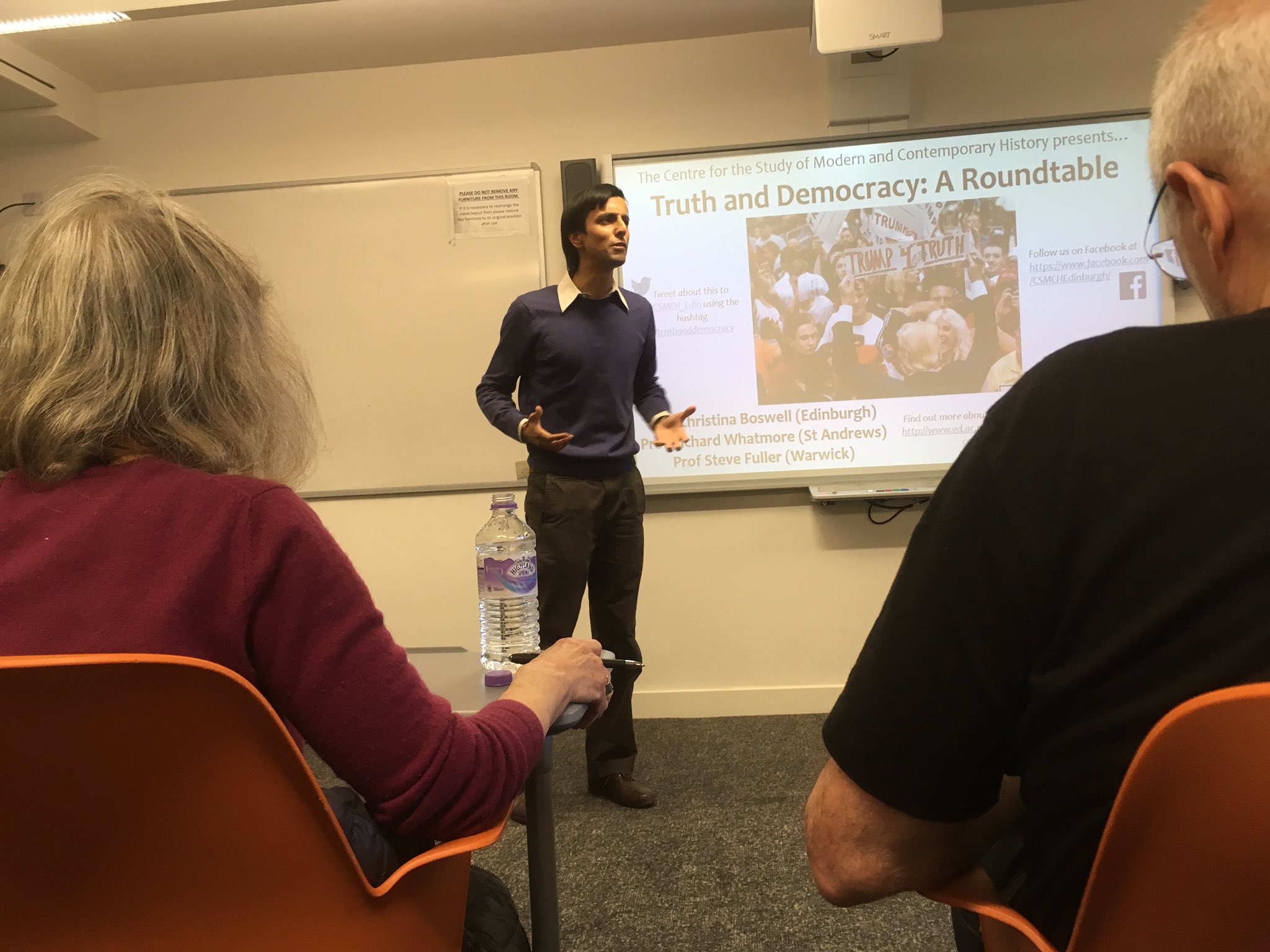
Our first event of the year – a roundtable on ‘Truth and Democracy’ – took place last night in a packed room in the David Hume Tower. Centre director, Emile Chabal, gives a flavour of the discussion. You can also click on the links to the podcasts if you would like to listen to each speaker’s presentation in full.
Emile Chabal welcomes people to the roundtable
The topic of the roundtable was, as one of the speakers pointed out, a very ambitious one. There is nothing self-evident about ‘democracy’, much less ‘truth’. But we were lucky to have three distinguished speakers to offer contrasting perspectives. Unusually for a history seminar, the evening was characterised by sharply diverging opinions, both in the initial presentations by the speakers and the lively discussion afterwards.
Our first speaker was Christina Boswell, Professor of Politics at the University of Edinburgh. She is one of the leading experts in the fields of knowledge, public policy, and migration. Drawing on her extensive research on policy makers in the UK and elsewhere in Europe, she suggested that ‘truth’ was not – and should not – be a key factor in democratic politics. Instead, she proposed that we think in terms of ‘trust’.
Looking specifically at contemporary politics, she also pointed out that the emergence of performance targets and ‘new public management’ in the 1990s were initially conceived as ways to demonstrate the ‘truthfulness’ and ‘trustworthiness’ of political claims. But these measurements have proved to be, at best, a mixed blessing.
Christina ended her talk by exploring the tensions between a ‘ritualistic’ respect for supposedly objective ‘data’ and ‘targets’, and a more ‘impressionistic’ belief in the value of symbolic cues.
Our second speaker, Richard Whatmore, is Professor of Intellectual History at the University of St Andrews. He opened his talk with the arresting claim that, historically, political thinkers have generally seen representative democracy as a form of ‘deceit’, which purports to empower the people, but only does so very briefly at election time. He also reminded us that most of these same thinkers have been very fearful of mob rule and altogether sceptical about the principle of democracy.
In the latter part of the presentation, Richard turned his attention to Adam Smith and David Hume, and in particular their discussions of the relationship between commerce and politics. Smith and Hume had stark warnings about the corruption of politics by commerce and, in today’s neo-liberal society, there was ample evidence of what this might mean in practice.
Richard ended by suggesting that politicians and political actors have become too closely intertwined with the worlds of business, lobbying and trade. In the process, they are losing their sense of duty and the common good.
Our final speaker, Steve Fuller, is Auguste Comte Chair of Social Epistemology at the University of Warwick. In his brief presentation, he challenged us to rethink the notion of ‘post-truth’. Rather than view this terms in a purely negative light as a ‘distortion’ of the truth, he argued that we would be better off seeing it as a recognition of the intractable and essentially contested game of politics.
To illuminate his point, he repackaged Machiavelli and Pareto’s metaphor of the ‘lions’ and the ‘foxes’. The lions are those who defend the status quo; the foxes are those who seek to overturn it. In the current context, Brexit and Trump could be considered examples of the foxes taking charge.
The important point, however, is that a post-truth world is one in which we do not simply participate blindly in this battle between lions and foxes, but begin to recognise that this game is actually happening in the first place. Post-truth, in Steve’s words, is a ‘meta’ understanding of politics.
The question and answer session that followed the three talks was as wide-ranging and stimulating as the talks themselves. Members of the audience raised questions about everything from Facebook to Habermas, and there was a robust exchange between the speakers about the relative importance or otherwise of basic standards of ‘truth’ in a democratic system.
All in all, this was a wonderful way to kick off this year’s programme – learned, polemical, thoughtful, and far-reaching. We’ve set a high bar for the rest of the year!